
Danville Previous Residents Sources
No single Danville record proves every past resident. The first layer is the land trail, followed by annual directories, census schedules, maps, permits, newspapers, and probate. The table separates what each source can establish from what it cannot. A deed records parties to a transaction, for example, while a directory gives an editor’s annual address clue. Reading them together is stronger than making either one say more than it does.
| Source | Years It Covers | Where Held | What It Shows |
|---|---|---|---|
| Circuit Clerk land records | 1841 to present, as stated by the city | Clerk, SRA, courthouse counter, and historical LVA material | Recorded instruments, parties, legal description, and references; images vary by access route. |
| Danville deed indexes | LVA reels list grantor and grantee indexes for 1939 to 1966 | Library of Virginia reels; clerk and SRA for current work | Names and deed references that lead to the instrument. |
| City directories | 1879 onward in identified runs; library statement covers 1920 to 1978 | Danville Public Library and selected databases | Name, address, occupation, and annual household clues. |
| Federal census | Released schedules through 1950 | NARA and library databases | Household snapshot at the census date. |
| Sanborn maps | 1886, 1890, 1900, 1910, 1915, 1920, 1937, 1947, and 1954 | UVA, LOC, library references, and city georeferencing work | Footprint, materials, use, and street context, not ownership. |
| Newspapers and probate | Digitized newspaper material 1866 to 2015; LVA fiduciary books 1874 to 1902 | DigiFind-It, library, clerk, and LVA | Notices, family context, heirs, inventories, and alternate addresses. |
Danville is an independent city. A nearby Pittsylvania County record belongs in a separate jurisdictional trail unless the address or event was actually in that county.
Preserve a Danville Address Identity
Before searching for past residents, open the address in Danville MapInsights. Copy the current site address, parcel account, map number, and legal description. The site address locates the parcel; the mail1, mail2, and mail4 fields are tax-mail fields and can point somewhere else. A legal description, which may use lot, block, feet, subdivision, or deed-book language, is the best continuity key when a street number changes.
The City Assessor maintains the current ownership, mailing-address, appraisal, and parcel-map layers. Those fields are leads, not a complete household list. A blank, different, or out-of-town mailing value should be copied as printed rather than turned into an occupancy claim.
- Parcel account
- The city’s identifying number for a tax parcel.
- Situs address
- The location of the parcel on the ground.
- Legal description
- The recorded land identity, often using lot, block, or metes-and-bounds wording.
- Tax mailing address
- The address used for tax correspondence. It may not be where the owner lives.
Danville Previous Residents Deed Chain
The Danville Circuit Court Clerk describes city land records from 1841 to the present. Its land-record route and Virginia Secure Remote Access are the starting points for the index, but remote images require local-clerk authorization or subscription. If an image is not available remotely, use the courthouse public terminal, request a clerk copy, or turn to Library of Virginia microfilm and originals.
- Search the current owner as grantee for the likely acquisition period.
- Open or request the deed and record grantor, grantee, recording date, book/page or instrument reference, consideration when shown, legal description, and prior-deed citation.
- Search that seller as a prior grantee, then repeat the comparison of legal description and lot or block.
- Stop or flag the chain when the land identity changes, an image is unavailable, or a deed refers to a tract rather than the target parcel.
A grantor transfers an interest. A grantee receives it. A chain of title is the sequence of recorded transfers for the same land. None of those terms proves that a named party slept at the address, so the previous residents question needs the household sources that follow.
Note: Record the source type and date beside every name because recording, publication, and residence dates do not match automatically.
Danville Previous Residents Records Since 1841
The 1841 city land-record statement is a useful lower boundary for the recorded-land trail, not a promise of identical online access for every volume. Library of Virginia holdings add depth: Danville deed-index reels list 1939 to 1966, and its local-government material includes court, fiduciary, marriage-index, and council records. That combination gives a practical fallback when an SRA screen does not reach an older book or when only an index reference is visible.
The Library of Virginia Danville microfilm collection is shown in this source capture.
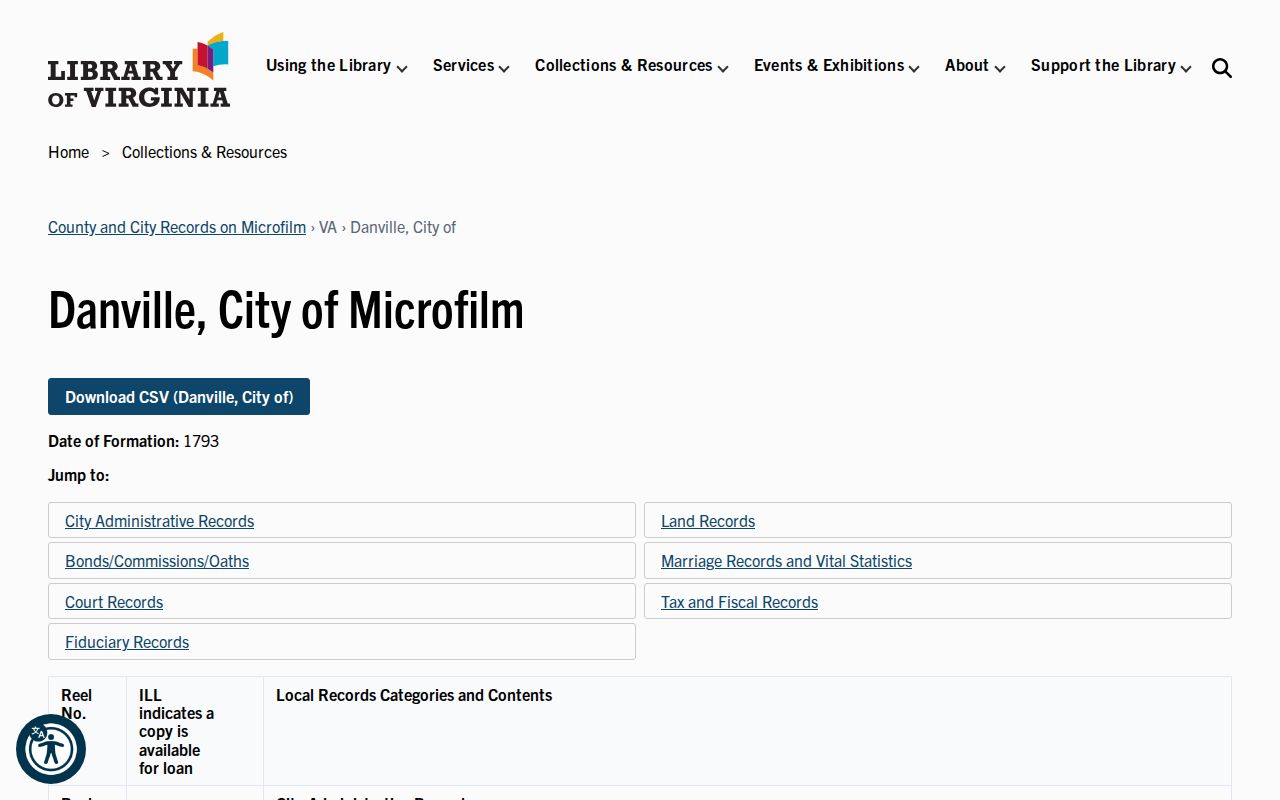
The collection is especially useful for a backward trail because it keeps local court and civic material alongside deed-index evidence, rather than treating a modern web result as the whole record.
For a bounded research request, name the street, parcel identity, target years, record group, and whether an index or image is needed. The clerk remains the custodian of current land, estate, and court files.
Danville Previous Residents Household Trail
After a deed names a party, use the historical household layer. The Danville Public Library genealogy desk provides local directories, black-and-white newspaper microfilm, FamilySearch, and in-library or staff-assisted research resources. Its stated directory holdings and the identified publisher runs make it possible to check a street or alphabetical entry around the time of a recorded transfer. Search a street section first, then the alphabetical listing, and note the publisher, year, page, and abbreviation key.
- Choose directory years just before and after the deed date.
- Match the printed address with the current parcel’s legal description and the historic street spelling.
- Pair the strongest directory years with released federal census years, noting that the census is a date-specific household snapshot.
- Use the Danville digital newspaper archive for obituary, marriage, civic, or street references, then verify a claim against a record of the right type.
The complete collections are described in the Danville city directory. Here, a directory entry is treated as a date-stamped address clue within one property trail.
Danville Previous Residents Building Dates
Sanborn maps help answer a different question: what was built at the address and how did the block look in a given year? The DHR survey bibliography identifies Danville maps from 1886 through 1954. The University of Virginia Sanborn guide explains how city, date, and volume organize the Virginia collection.
The Sanborn guide is shown in this source capture.
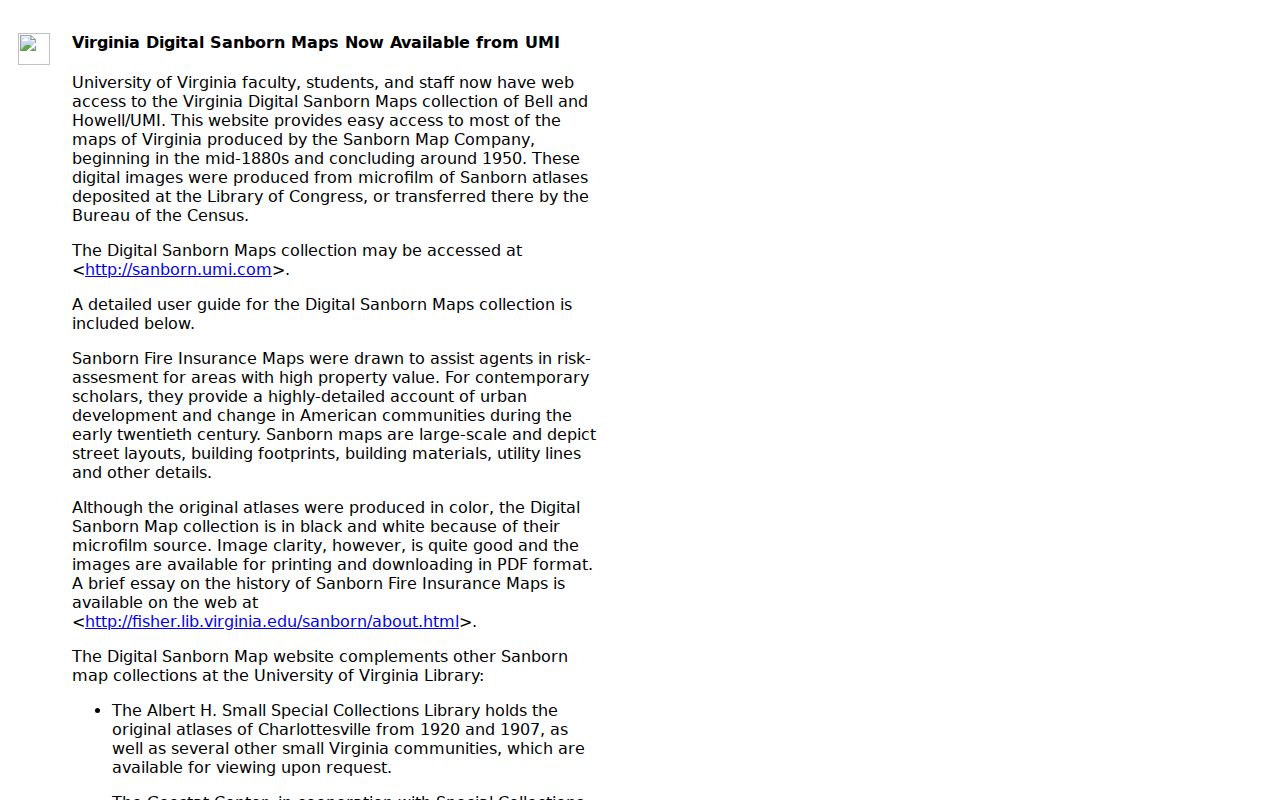
Danville’s 1954 maps were also digitized and georeferenced against the current map in a city archival project. Use a footprint match to test address continuity, then return to directories and recorded land records for people and ownership.
Danville Previous Residents Locality Names
North Danville and Neapolis were annexed in 1896. That local geography is an important research feature, not a reason to overwrite old labels. The Turner directory of 1887 explicitly combines Danville and North Danville, and Library of Virginia microfilm preserves North Danville council proceedings, including an 1877 to 1883 index and an 1887 to 1890 cash book. Search all relevant locality names when an address sits near the historic boundary.
A street number can also fail to line up across time. No comprehensive official Danville renumbering list was found. Compare old directory street indexes, Sanborn sheets, legal descriptions, former street spellings, and neighboring parcels instead of assuming a number stayed fixed.
Danville Previous Residents Endpoints
Obituaries and probate can close or correct a household trail. A notice may name a spouse, parent, organization, or last address. A will, inventory, account, or other estate file can name heirs and property. The Danville public-records description identifies the Circuit Clerk as custodian for wills and estate papers, while LVA lists fiduciary books from 1874 to 1902. Treat each as evidence of the stated event, not a shortcut to a modern household claim.
A record request under the Virginia Freedom of Information Act reference should be specific about record type and date range. VFOIA does not convert protected or nonpublic information into an open address list.
Danville Previous Residents Notes
A solid trail retains five address identities when the sources supply them: current USPS street and ZIP label, GIS situs, tax mailing address, deed legal description, and the historical directory spelling or number. A note that says “same property not yet confirmed” is better than a polished but unsupported chain. This is particularly important around North Danville, Neapolis, and the city’s separate jurisdiction from Pittsylvania County.
Keep the dates separate as well. A deed recording date marks the recordation event. A directory year reflects a publisher’s annual compilation. A census date records an enumerator’s snapshot. A newspaper date may show when an event was reported, not when a household moved. The strongest Danville previous-residents result identifies which date belongs to which source and leaves conflicts visible for later checking.
The city’s reported 2026 back-scanning initiative says deed books and indexes back to 1841 were digitized and uploaded. It is a useful access milestone, but it does not remove the SRA image authorization, subscription, clerk-copy, or courthouse-terminal caveats that apply to an individual instrument.
For current address information after the history work ends, use the Danville street directory rather than carrying historical directory clues forward as present facts.